Kloepping branch · Generation 6 · ID I43
Anna Christine Charlotte Bähr
? – ?
- Newly added by the research expansion; not yet independently re-checked
Facts
- Birthplace
- Vahlhausen Amt Detmold, Principality of Lippe, Germany
Relationships
- Spouse / co-parent Simon Henrich Bracht
- Child Anna Marie Wilhelmine Louise (Louisa) Bracht
Research notes
Mother of Anna Marie Wilhelmine Louise (Louisa) Bracht (wife of Wilhelm Klöpping).
Life and times
General historical context. This section describes the times and places this person lived in. It is not documented fact about them; “likely” means just that.
Places
- Vahlhausen Amt Detmold, Principality of Lippe, Germany ca. 1788-ca. 1852
What was happening
- 1807 Napoleonic Reorganization and Confederation of the Rhine · Principality of Lippe, Germany
Running a rural household in Vahlhausen, Anna Christine would have likely contended with price inflation and household requisitioning under Napoleonic wartime governance. Source - 1813 Allied Troop Movements and Liberation in Westphalia · Principality of Lippe, Germany
Anna Christine would have likely experienced the strain of billeting soldiers and providing provisions as Allied armies marched through northern Germany following the Battle of Leipzig. Source - 1816 The Year Without a Summer Crop Failures · Principality of Lippe, Germany
As a mother managing household grain supplies in Vahlhausen, Anna Christine would have likely rationed flour and endured intense anxiety over widespread food scarcity. Source - 1831 Second Cholera Pandemic Enters Central Europe · German Confederation, Germany
Anna Christine would have likely observed strict quarantine cordons, market travel bans, and religious days of prayer implemented across Lippe to avert the spread of cholera. Source - 1845 European Potato Failure and Food Inflation in Lippe · Principality of Lippe, Germany
Living in a multigenerational agricultural home, Anna Christine would have likely adapted family meals and stretched garden provisions when potato blight decimated village fields. Source - 1848 Revolutionary Agitation and Rural Emigration Fever · Principality of Lippe, Germany
Anna Christine would have likely participated in earnest family discussions as economic distress and political volatility sparked widespread interest in emigrating to North America, a journey her daughter Louisa would soon undertake. Source
In context
Anna Christine Charlotte Bähr lived during a transformative epoch in northwestern Germany, experiencing the daily realities of domestic and farm life in the Principality of Lippe. Residing at Hof Nr. 6 in Vahlhausen Amt Detmold alongside her husband Simon Henrich Bracht, she managed household production, vegetable gardens, poultry, and linen spinning within a close-knit rural community. Her early motherhood unfolded against the backdrop of the Napoleonic Wars, marked by anxieties over troop movements, price volatility, and heavy requisitioning by foreign armies. In 1816, the climate anomalies of the 'Year Without a Summer' tested her resourcefulness as flour and staple foods grew desperately scarce across Westphalia. In subsequent decades, she nurtured a growing family, including her daughter Anna Marie Wilhelmine Louise (Louisa) and sons who established independent farming livelihoods. When regional potato rot struck Lippe in 1845, accompanied by food price inflation and hunger riots in Detmold, Anna Christine adapted family resources to endure the agrarian crisis. In her twilight years, she observed the revolutionary fever of 1848 and heard earnest household debates that soon propelled her daughter Louisa to seek a new destiny in America.
Pictures from their world
Public-domain and openly licensed images of the places and times this person lived in. None are photos of this person; documents are period examples only.
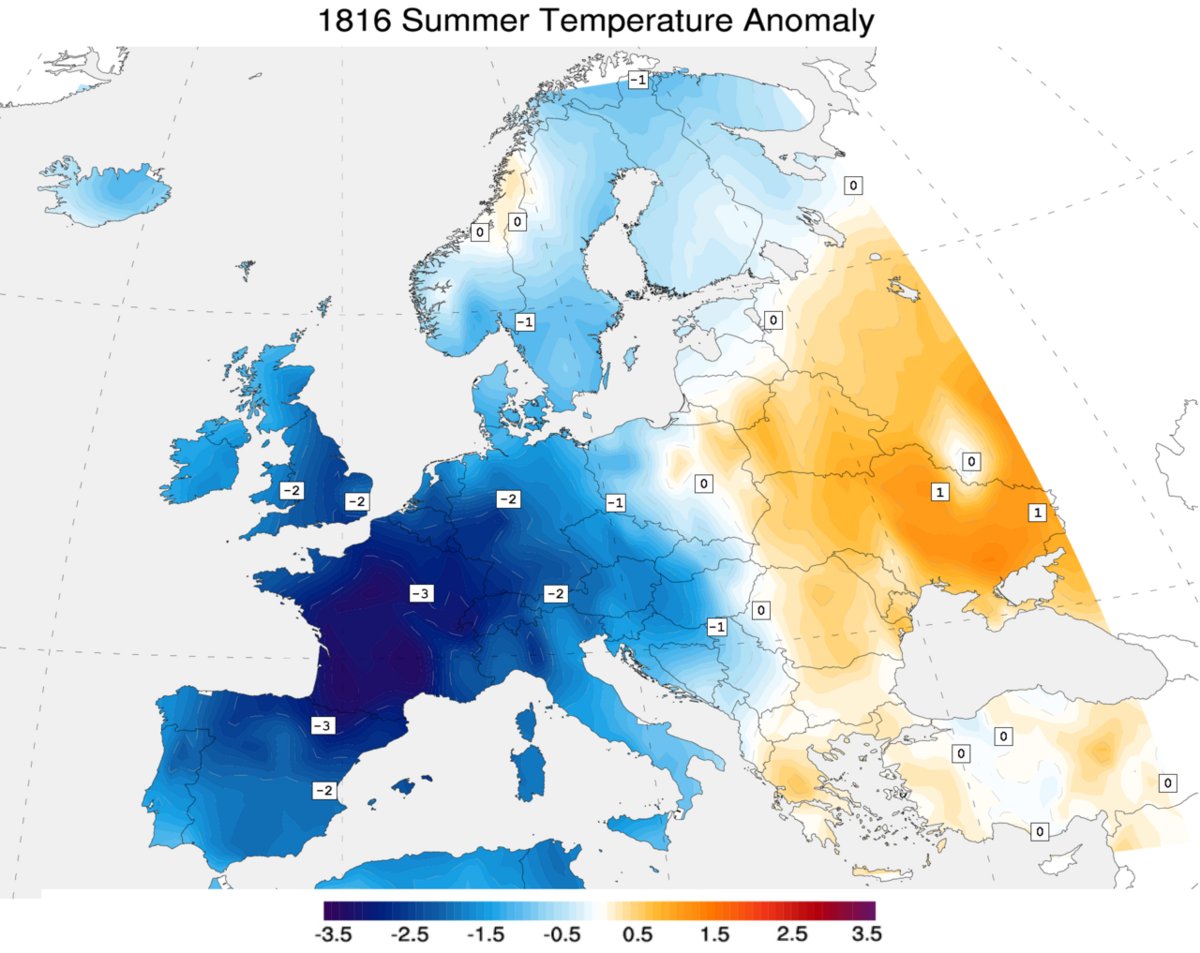
1816 summer temperature anomaly (°C) with respect to 1971-2000 climatology. Data source: ftp://ftp.ncdc.noaa.gov/pub/data/paleo/historical/europe-seasonal-files/Giorgiogp2, 1816. CC BY-SA 3.0 (share-alike). Source




Naturdenkmal 1 Eiche nordöstlich der Kläranlage am Niederbeller Bach in Horn-Bad Meinberg-BelleTsungam, 1807. CC BY-SA 4.0 (share-alike). Source
